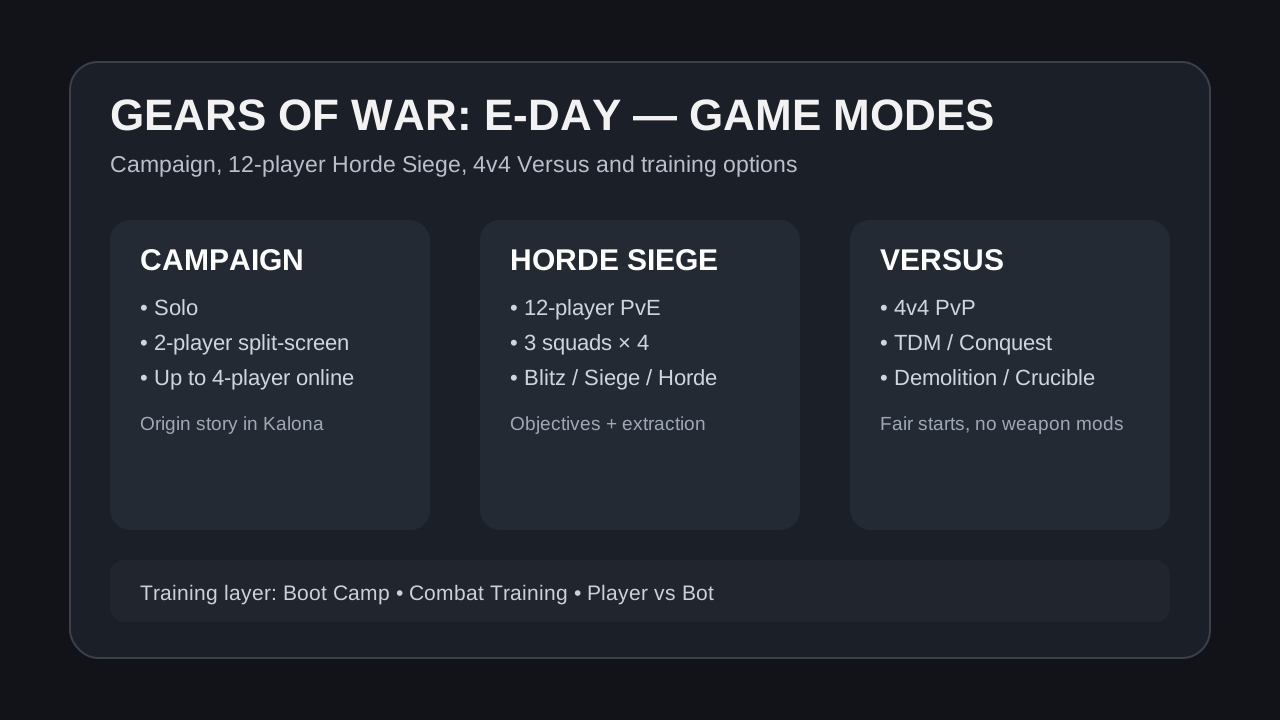
Gears E-Day multiplayer is built around two very different kinds of squad play. Horde Siege expands PvE into a 12-player battlefield where three squads of four operate across the same Kalona map, while Versus keeps competitive multiplayer deliberately tighter with 4v4 teams, equal starting loadouts, Power Weapons, and four core launch modes. The Coalition has also detailed progression, training, cosmetics, six Versus maps, three Horde Siege maps, and five planned post-launch multiplayer seasons.
That is much more specific than the early “multiplayer is coming” messaging. As of September 6, 2026, the August beta weekends are over, so this guide now focuses on the confirmed October 6 launch structure rather than beta access instructions. It also separates Horde Siege progression from Versus rules because systems such as classes and Weapon Mods do not work the same way across both modes.
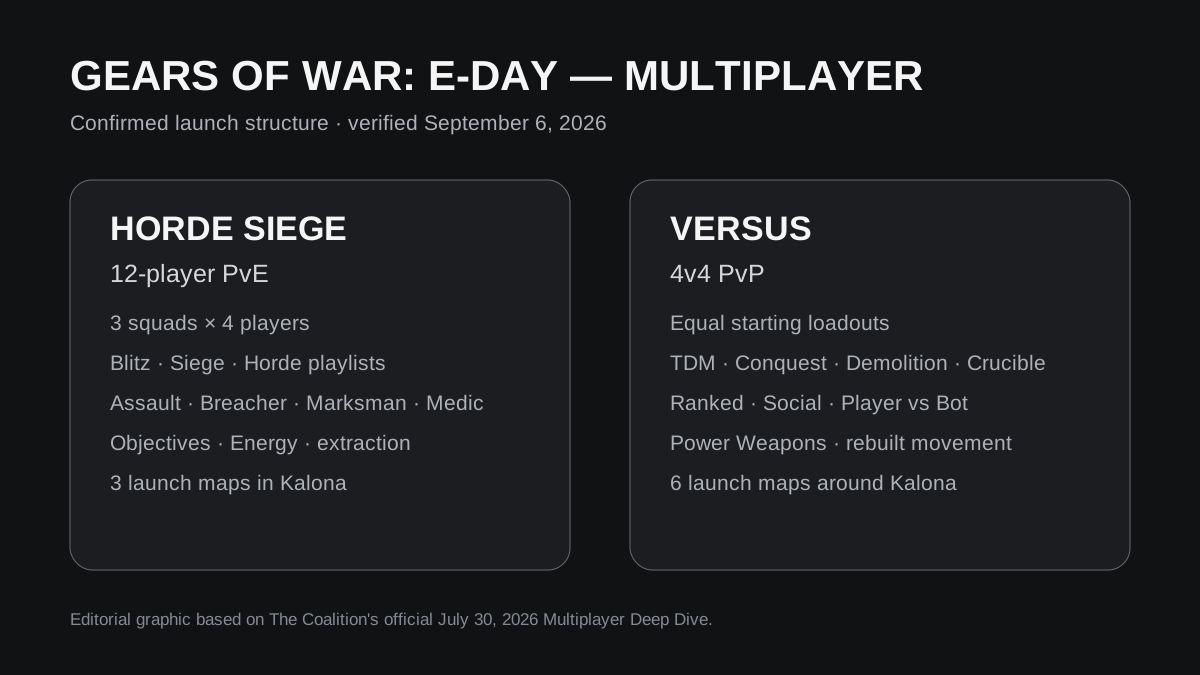
Gears E-Day multiplayer at a glance
| Feature | Horde Siege | Versus |
|---|---|---|
| Format | PvE co-op | PvP |
| Player count | 12 players, three squads of four | 4v4 |
| Launch maps | 3 | 6 |
| Main formats | Blitz, Siege, Horde | Team Deathmatch, Conquest, Demolition, Crucible |
| Classes | Assault, Breacher, Marksman, Medic | No Horde class system |
| Weapon Mods | Yes | No |
| Main progression | Class XP, mods, Weapon Parts, rewards | Ranked/Social progression plus shared player progression |
| Core goal | Complete objectives, survive and extract | Defeat the opposing team under mode-specific rules |
The shared foundation is still recognizably Gears: cover, movement, weapon control, teamwork and brutal close-range fights. The difference is scale. Horde Siege is designed around a battlefield that can keep changing around your squad; Versus strips the match down to two teams competing on a controlled map where everyone starts on equal terms.
Horde Siege is a 12-player evolution of Horde
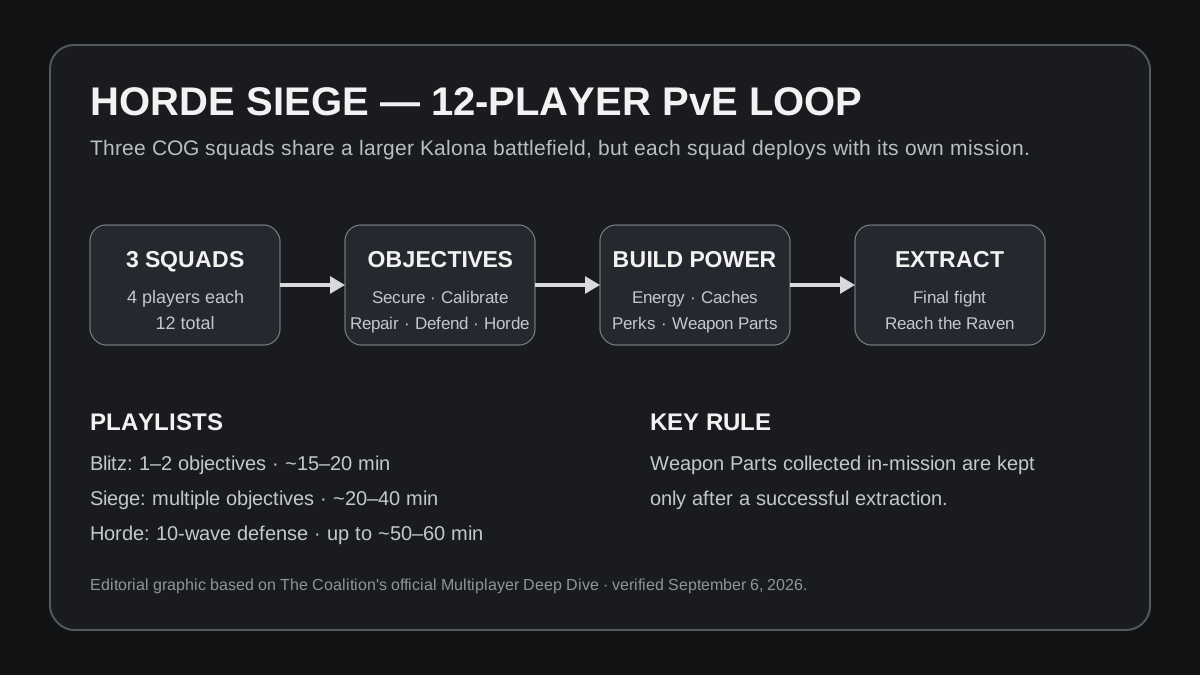
Horde Siege is the biggest structural change in E-Day multiplayer. Instead of placing one team in a fixed arena for a traditional wave marathon, the mode puts three COG squads of four onto large maps built from districts of Kalona. Each squad receives its own mission and can cross paths with the other squads as the battle develops.
That does not mean all 12 players are permanently stacked together. The official design is closer to several squads fighting inside one persistent conflict. Your group might be repairing a R.I.G. while another squad handles a different objective elsewhere. An Invasion Event can then create a threat large enough to pull multiple squads toward the same fight. The Coalition specifically uses bosses such as the Corpser and Brumak to illustrate these battlefield-wide events.
The maps are correspondingly larger. The Coalition says Horde Siege maps span multiple city blocks and provide more space and combat opportunities than previous Horde maps. Golden Quarter was the beta map, while the full game is scheduled to launch with three Horde Siege maps, with more planned after release.
For the dedicated rules, objective loop and strategy layer, see our Horde Siege guide.
Blitz, Siege and Horde playlists
Horde Siege is not one fixed-length activity. It has three main mission playlists:
- Blitz is the quick option, generally built around one or two objectives and an estimated 15–20 minute run.
- Siege is the standard mission format, with multiple objectives and more movement across the map. The official estimate is roughly 20–40 minutes.
- Horde asks the squad to dig in and survive 10 waves with limited support, with runs potentially reaching 50–60 minutes.
These are design targets rather than guaranteed timers. Difficulty, squad performance, optional objectives and wipes can all change the real duration. The useful takeaway is that E-Day lets players choose a shorter objective run without removing the longer defensive experience associated with classic Horde.
Most missions revolve around R.I.G.s, or Resonation Imaging Geographers. These mining devices have been repurposed by the COG to map Locust tunnels beneath Kalona. Launch objective types include Secure, Calibrate, Repair, Defend and Horde. Secondary objectives add optional risks such as high-value targets or resource tasks in exchange for rewards.
Horde Siege classes
Four classes are confirmed for launch: Assault, Breacher, Marksman and Medic. The class determines a starting loadout, combat bonus, progression path and Tactical Gear, but it does not lock the player to a specific character skin.
| Class | Role | Tactical identity |
|---|---|---|
| Assault | Flexible mid-range fighter | Sonic Disruptor can stun incoming enemies; gains a cover damage bonus |
| Breacher | Aggressive close-range fighter | Adrenaline Injector restores health and reduces incoming damage |
| Marksman | Precision damage | Pulse Drone tags enemies; class gains stronger critical damage |
| Medic | Healing and revival | Stim Vaporizer can heal and revive nearby Gears, including players from other squads |
There is deliberately no mandatory “one of each” composition. The Coalition even gives a four-Breacher squad as an example of a valid setup. That leaves room for players to build around the mission, difficulty and their preferred weapons instead of treating the four roles as a rigid MMO party template.
Each class has 30 progression levels at launch. Class XP unlocks loadout options, equipment, Armor Mods, Tactical Gear Mods and Weapon Mods. Our Horde classes guide goes deeper into what each role is designed to do.
Energy, Weapon Parts and extraction matter
Horde Siege adds an economy inside each mission. Completing objectives and killing enemies adds Energy to a shared squad pool. Players then spend individually at Supply Caches on equipment, Squad Perks or weapons. Energy can also support defensive positions and turret upgrades.
The interesting decision is whether to spend for the immediate fight or invest toward later objectives. Secondary activities can provide extra Weapon Parts, equipment and perks, but they also consume time and expose the squad to more danger.
Weapon Parts are especially important because they unlock Weapon Mods. The Coalition says that, for the first time in a mainline Gears title, iconic weapons can be modified in this way. A successful extraction matters: Weapon Parts found during a mission are only retained if the squad completes the mission successfully. Weapon customization is shared across classes once unlocked, so a configured weapon does not have to be rebuilt from zero for every class that can equip it.
Death also has a squad-level consequence. A killed player drops COG tags that teammates can recover and return to a Supply Cache for revival; even players from another squad can help. A complete squad wipe consumes a squad life. Run out of squad lives and the mission fails, although partial XP is still awarded.
Versus is 4v4 across every core mode
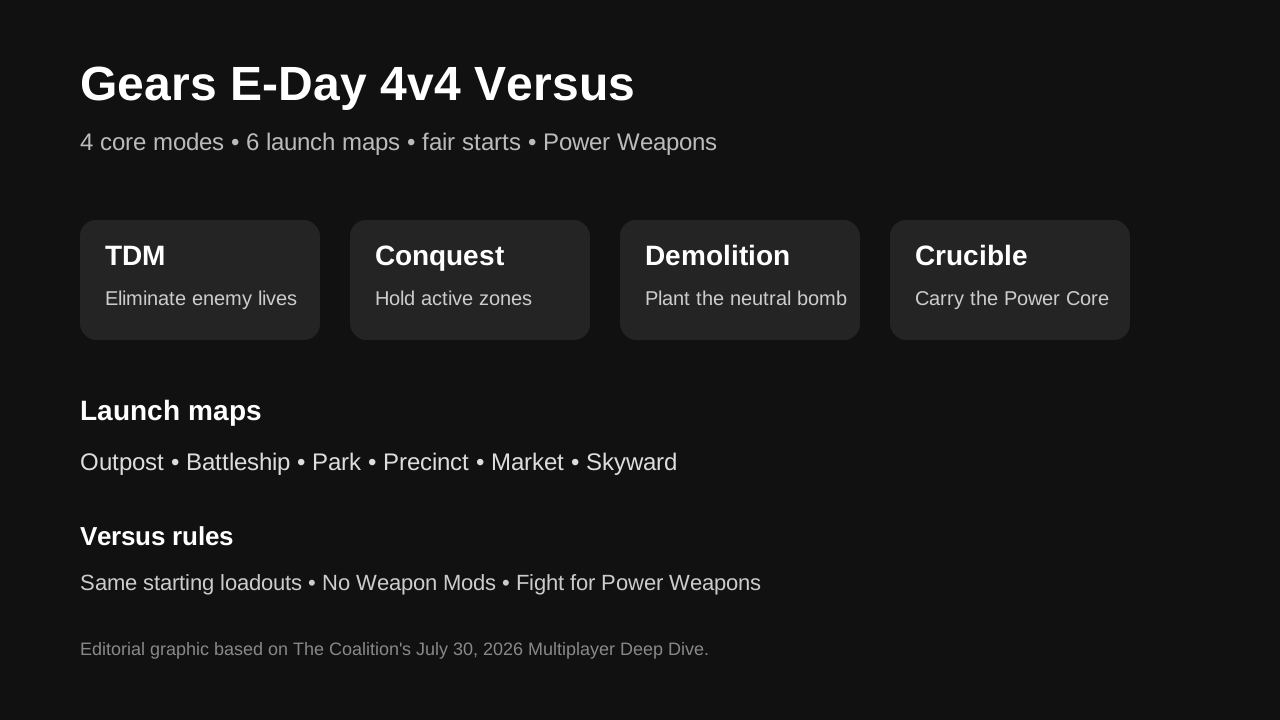
Competitive Versus is 4v4. The Coalition says all players begin with the same loadout weapons and equipment, and Weapon Mods are disabled in Versus. Competitive advantage therefore comes from movement, positioning, teamwork and controlling Power Weapons on the map rather than bringing a stronger customized gun into the lobby.
Four core modes are confirmed for launch:
Team Deathmatch
TDM returns around team lives rather than a simple kill-score race. E-Day adds dynamic respawns that can shift spawn locations in response to the flow of the fight, reducing the assumption that a team will always re-enter from one predictable area.
Conquest
Conquest reworks the familiar zone-control idea. Teams occupy an active zone and build progress, but the zone does not simply rotate on a fixed interval. It remains active until one team accumulates enough control time to score, which makes a late contest meaningful.
Demolition
Two teams fight over a neutral bomb and attempt to plant it at one of two enemy bombsites. After the bomb is armed, the planting side must defend it without respawns. Three successful detonations win the match.
Crucible
Crucible is the new mode in the launch group. Teams fight for a heavy Power Core and score by carrying it inside an active zone. The zone moves and shrinks as the round develops, while the Power Core itself can release an electrical blast as a last defensive option for its carrier.
For a mode-by-mode competitive explanation, see the E-Day 4v4 guide.
Six Versus maps at launch
E-Day is scheduled to ship with six new Versus maps, all connected to Kalona and its surroundings:
- Outpost — an abandoned military camp with rolling terrain, bunkers and an elevated bridge.
- Battleship — a wartime vessel being dismantled, with exposed decks, crossings and docks.
- Park — the ruins of a coastal zoo, mixing open sightlines around the fountain with alternate paths through exhibits.
- Precinct — the damaged Kalona Police Department, favoring close interiors, breached walls and flanking routes.
- Market — a ruined seaside market with long streets, balconies and dense interior spaces.
- Skyward — interconnected rooftops with jumps, exposed crossings and high-ground risk.
The Coalition describes these maps as rooted in classic Gears design: symmetrical structure, cover positions, fronts and lanes. They are also built around E-Day's expanded movement options, so routes can make use of vaulting, jumping and other traversal changes that were not available in exactly the same way in older games.
Ranked, Social and ways to practice
Versus separates Ranked and Social play. Ranked playlists have mode-specific skill and rank systems, placement matches and quitting penalties. Rank Rating changes with match outcomes and performance, while Skill Division represents the matchmaking estimate of a player's relative skill.
Social is the broader casual structure. It includes 4v4 Quickplay, Player vs Bot and rotating experiences. Lobbies can vote on the next match, helping groups stay together instead of forcing a full restart after every game.
New or returning players also have two dedicated learning spaces. Boot Camp is a short training course for controls and mechanics. Combat Training expands practice onto a multiplayer map, lets players experiment with weapons and short Locust encounters, and supports four-player co-op. These are useful additions because E-Day rebuilds movement and cover rather than assuming every veteran wants the exact control feel of an older Gears title.
E-Day's rebuilt movement affects both PvE and PvP
The July gameplay update makes an important point: Campaign, Horde and Versus share a unified gameplay sandbox. Cover has been rebuilt with more cover heights and actions, including low-ground cover that can force a character into a lower defensive posture. Movement is designed to retain the weight of an armored Gear while offering more momentum and flexibility.
That matters differently in each multiplayer pillar. In Horde Siege, greater movement supports wider maps, objective travel and emergency repositioning when a boss or invasion event changes the fight. In Versus, the same tools create new flank routes and risk-reward decisions without removing the importance of cover and Power Weapons.
The Snub, Smoke Grenades and Heavy Weapons have also received changes. Smoke uses volumetric effects to block player and AI sightlines, while Heavy Weapons allow more movement than before and can be detached from turret bases. See the movement guide for the mechanics without turning this multiplayer hub into a controls manual.
Progression, skins and customization
At launch, E-Day is planned to include more than 60 character skins across COG and Locust characters. Horde class and character appearance are separate choices, so selecting Medic does not force one specific hero. Major campaign characters and their skins are intended to be unlockable on day one.
Customization categories include character skins, weapon skin sets, poses, banners, emblems, icons, titles and menu music. The Coalition says most content can be earned through play, while Premium Edition content, charity offers and some partnership items are exceptions.
The free-to-earn Coins currency comes from multiplayer matches, Player Level milestones and medals. Player Level caps at 100 before a Re-Up, and players can Re-Up four times for a total progression span equivalent to 500 levels. Weekly, seasonal, event and foundation challenges add further goals across Horde Siege and Versus.
Five post-launch multiplayer seasons are planned
The Coalition has committed to five themed post-launch multiplayer seasons, beginning with Season 1: Emergence. The stated plan includes new maps, modes, characters, skins, Horde Siege classes and limited-time events. More detailed roadmap timing has not yet been published, so this page treats the five-season commitment as confirmed while avoiding invented dates or season contents.
That distinction is important for SEO pages written before launch: “more content is planned” is supported; a detailed schedule for every map or class is not.
What happened to the multiplayer beta?
The multiplayer beta is now historical rather than an upcoming event. Early Access ran August 6–10, 2026, followed by the Open Beta August 13–17, 2026. It gave players access to Horde Siege and 4v4 Versus before launch.
If you are arriving here in September looking for a beta code, there is no current beta window to enter. The useful next milestone is the full game's October launch. Beta-specific troubleshooting should therefore be treated as archived information rather than mixed into the main multiplayer guide.
Gears E-Day multiplayer FAQ
How many players does Horde Siege support?
Horde Siege supports 12 players, arranged as three squads of four operating on the same large PvE battlefield.
Is Gears E-Day Versus 4v4?
Yes. The Coalition's current launch plan uses 4v4 for all Versus modes. Players begin with equal loadouts, and Weapon Mods are disabled in competitive Versus.
What multiplayer modes launch with E-Day?
The two pillars are Horde Siege and Versus. Horde Siege offers Blitz, Siege and Horde mission playlists. Versus launches with Team Deathmatch, Conquest, Demolition and Crucible, alongside Ranked and Social structures.
How many multiplayer maps are there at launch?
The announced launch plan is three Horde Siege maps and six Versus maps. More content is planned after release.
Does E-Day multiplayer have classes?
Horde Siege does. Assault, Breacher, Marksman and Medic are confirmed for launch. Versus does not use those Horde classes as competitive loadout advantages.
Is battle royale confirmed?
No. Battle royale is not part of the official launch multiplayer lineup reviewed for this update. Unless The Coalition announces one later, it should not be presented as a confirmed mode.
Can beginners practice before playing PvP?
Yes. Boot Camp teaches controls, Combat Training provides a larger practice environment and supports four-player co-op, and Social includes Player vs Bot options.
Bottom line
The launch version of Gears E-Day multiplayer has a clear identity. Horde Siege is the experimental side: 12-player PvE, three squads, large Kalona maps, classes, resources, Weapon Mods, objectives and extraction. Versus is the competitive counterweight: 4v4, equal starts, Power Weapons, four core modes and six purpose-built maps.
The shared rebuilt movement and cover systems tie those experiences together, while progression and customization provide the longer-term layer. With the August beta finished and the October 6 release approaching, the useful questions are no longer whether multiplayer exists or how to get a beta code. They are which mode fits your squad, how Horde Siege progression works, and how the new movement changes classic Gears PvP. Those are the areas this hub will continue to track as The Coalition publishes the final launch and seasonal roadmap details.