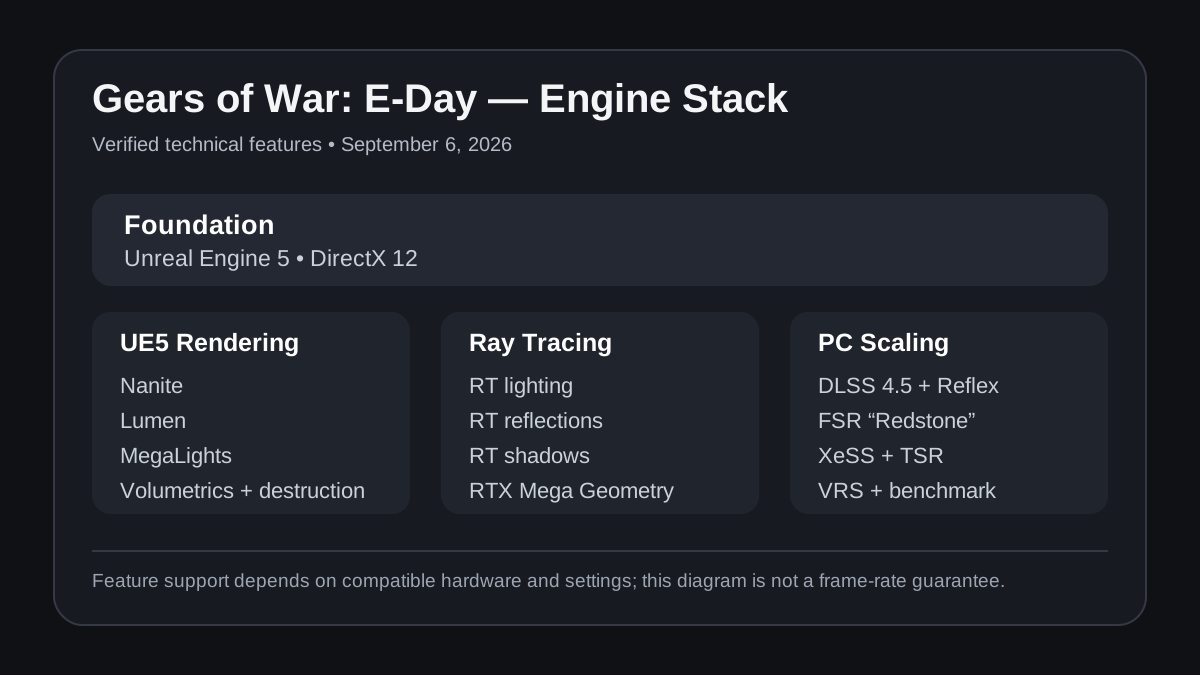
Gears of War: E-Day on PC is being positioned as one of the most technically ambitious entries in the series. The Coalition rebuilt the game from scratch on Unreal Engine 5, uses DirectX 12, requires a hardware ray-tracing-capable GPU, and has partnered with NVIDIA for features including DLSS 4.5, Dynamic Multi Frame Generation, Super Resolution, NVIDIA Reflex, and the newly announced RTX Mega Geometry.
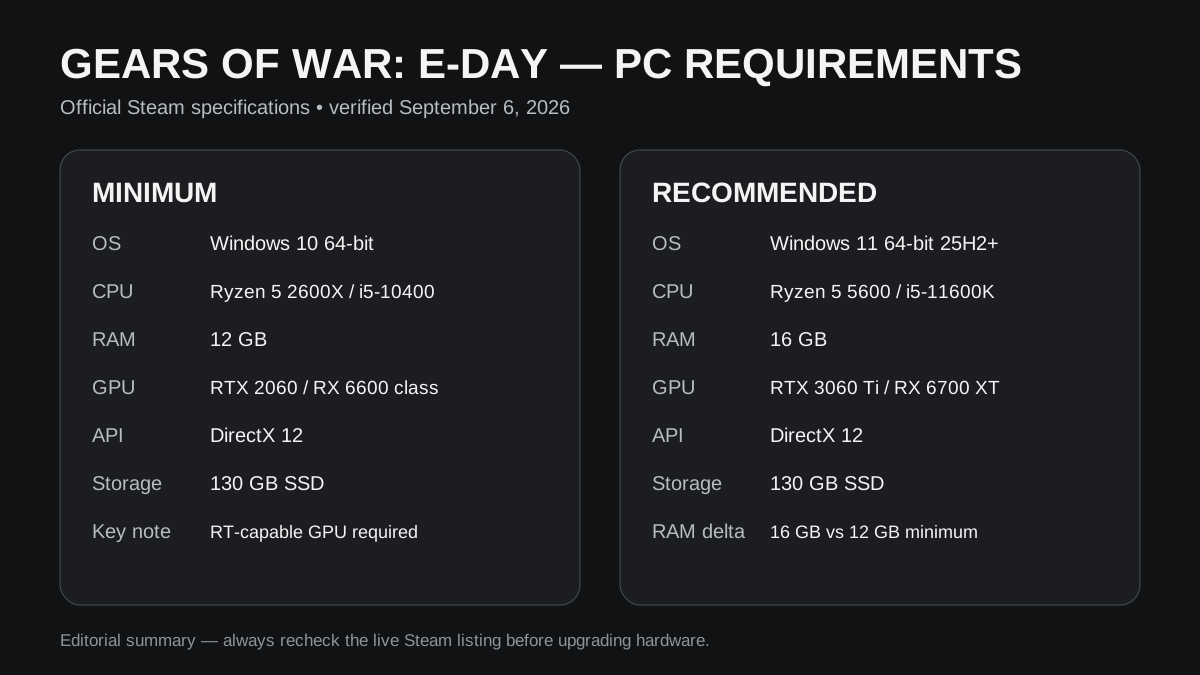
There is also an important update for anyone who has been waiting for concrete PC requirements: the official Steam listing now publishes both minimum and recommended specs. That means the older “requirements not yet announced” status is no longer current. The minimum spec calls for 12 GB of RAM, 130 GB of SSD storage, DirectX 12, and a ray-tracing-capable GPU; the recommended spec moves to 16 GB of RAM and stronger RTX 30/50-series or Radeon hardware.
What graphics technology does Gears E-Day use on PC?
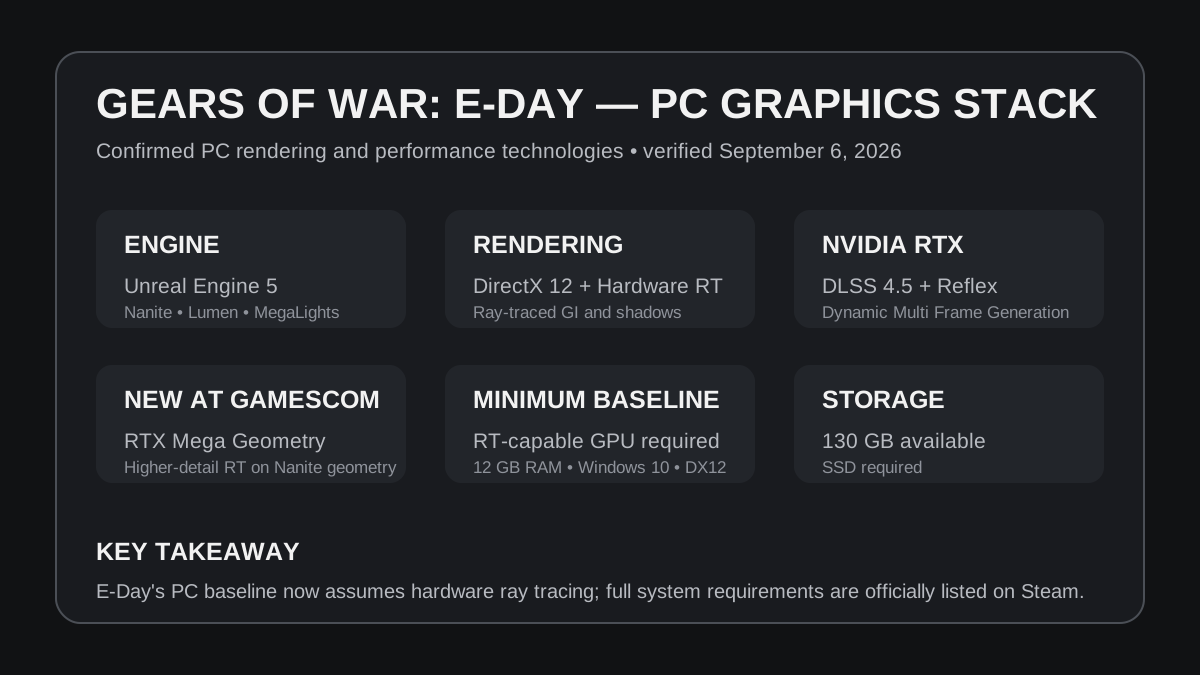
The PC version is built around Unreal Engine 5 and DirectX 12. The Coalition has said E-Day does not simply inherit old assets or systems from earlier Gears games; characters, weapons, enemies, animation, audio, and environments were rebuilt for the new project.
The engine work matters because several of E-Day's visual systems depend directly on modern UE5 rendering features. Official Xbox and NVIDIA material highlights Nanite, Lumen, and MegaLights as major parts of the visual pipeline.
- Nanite is used to push far more geometric detail than earlier Gears titles.
- Lumen provides ray-traced global illumination and ambient-occlusion-style lighting behavior.
- MegaLights is used for large numbers of dynamic ray-traced light sources and shadows.
- Hardware ray tracing is part of the PC rendering baseline rather than an optional curiosity attached only to ultra settings.
NVIDIA says Nanite can increase object detail dramatically compared with Gears 5, while the broader UE5 toolset allows for real-time destruction, dense particles, volumetric effects, and larger spectacle-heavy encounters.
Is hardware ray tracing required?
Yes. The current official Steam minimum requirements explicitly say that a hardware ray-tracing-capable GPU is required.
That is one of the most important technical facts about the PC release. This is not simply a case where ray tracing is an optional high-end toggle while older raster-only GPUs remain supported. The published baseline itself assumes ray-tracing-capable hardware.
The minimum GPU list currently includes examples such as:
- NVIDIA GeForce RTX 2060
- NVIDIA GeForce RTX 5050
- AMD Radeon RX 6600
- AMD Radeon RX 9060
The exact performance target attached to those minimum GPUs is not stated on Steam, so do not read “minimum” as a promise of a particular resolution, frame rate, or ray-tracing preset. It only establishes the supported baseline hardware class.
For the dedicated hardware table, see the Gears E-Day system requirements guide.
DLSS 4.5 support
On GeForce RTX hardware, E-Day launches with DLSS 4.5 support. NVIDIA specifically lists Super Resolution and Dynamic Multi Frame Generation.
Super Resolution renders the game internally at a lower resolution and reconstructs a higher-resolution output. Dynamic Multi Frame Generation is aimed at increasing displayed frame rate by generating additional frames when the hardware and selected mode support it.
The practical value depends on GPU class, base frame rate, target resolution, and image-quality preference. A player aiming for 4K with expensive ray-traced effects may use DLSS differently from someone targeting 1440p and low latency. The official announcements confirm the feature set, but they do not guarantee the same uplift on every GPU.
NVIDIA Reflex and latency
NVIDIA Reflex is also confirmed for launch. Its purpose is different from DLSS: Reflex is designed to reduce system latency and improve input responsiveness.
That is especially relevant to E-Day because the game is not only a cinematic campaign. It also includes competitive 4v4 Versus, where input delay and responsiveness can be noticeable during close-range fights, movement, shotgun exchanges, and Power Weapon contests.
The official NVIDIA material frames Reflex as a way to reduce PC latency. It is reasonable to expect the feature to matter most to players already pushing high frame rates, but final real-world results will depend on the completed game, drivers, CPU/GPU balance, and display setup.
What is RTX Mega Geometry?
The newest major PC graphics announcement came at Gamescom 2026, when NVIDIA revealed that Gears of War: E-Day will debut RTX Mega Geometry.
The problem this technology addresses is specific to detailed ray-traced scenes. Nanite can render extremely complex geometry on screen, but traditional ray-tracing acceleration structures can fall back to lower-detail representations because tracing every full-detail object is expensive. That can create a mismatch where the visible object looks detailed but its ray-traced shadow or reflection uses a simpler mesh.
RTX Mega Geometry is designed to reduce that mismatch by allowing much more detailed Nanite geometry to participate in ray tracing. NVIDIA's E-Day example points to small scene elements such as vehicles, shopping-cart spokes, foliage, rocks, cups, and other environmental objects gaining more accurate ray-traced representation.
For players, the important point is not the API terminology. It means the ray-traced version of the world can better match the actual geometric detail of the world being rendered.
Lumen and MegaLights
Two Unreal Engine systems are especially important to E-Day's lighting.
Lumen handles dynamic global illumination. In practical terms, this helps indirect light respond to changing environments rather than relying entirely on static baked lighting. That fits E-Day's collapsing-city setting, where fire, destruction, indoor/outdoor transitions, and emergency lighting are part of the atmosphere.
MegaLights is intended to handle large numbers of dynamic shadow-casting lights more efficiently. NVIDIA's beta technology description says E-Day can use MegaLights for ray-traced shadows from up to 100 light sources in relevant scenes.
That does not mean every scene literally contains 100 important lights, nor does it establish a universal performance cost. It describes the capability the rendering system is built to handle.
Official PC system requirements
The Steam requirements now give a useful baseline.
| Component | Minimum | Recommended |
|---|---|---|
| OS | Windows 10 64-bit 22H, build 19045.7291 | Windows 11 64-bit 25H2 or newer |
| CPU | Ryzen 5 2600X / Intel i7-6850K / i5-10400 | Ryzen 5 5600 / Intel i5-11600K |
| RAM | 12 GB | 16 GB |
| GPU | RTX 5050 / RTX 2060 / RX 6600 / RX 9060 | RTX 5060 / RTX 3060 Ti / RX 6700 XT / RX 9060 XT |
| DirectX | Version 12 | Version 12 |
| Storage | 130 GB | 130 GB |
| Drive type | SSD required | SSD required |
Steam also requires a broadband internet connection and lists a Windows-compatible audio device.
There are two details worth emphasizing. First, 130 GB is substantial enough that players should leave extra room for patches and unpacking rather than aiming for exactly 130 GB free. Second, the minimum row's ray-tracing requirement explains why older GTX-class cards are absent.
Does E-Day support AMD and Intel upscaling?
The official Xbox and NVIDIA July partnership announcement centers on NVIDIA because NVIDIA is the named exclusive PC technology partner. That should not be interpreted as proof that every non-NVIDIA upscaling option is unavailable.
The safest approach is to separate confirmed platform-wide information from partner-specific features. DLSS 4.5 and Reflex are specifically NVIDIA technologies. Broader PC rendering support should be read from final in-game options and platform documentation once the launch build is available.
This page will not label FSR or XeSS support as a launch guarantee unless it is documented by an official source tied to the final release build.
How powerful does your PC need to be?
The requirements suggest a wide supported range, but they also show that E-Day expects modern graphics hardware. An RTX 2060 or RX 6600-class GPU can satisfy the published minimum GPU floor, while the recommended list moves into RTX 3060 Ti / RTX 5060 / RX 6700 XT territory.
The missing information is the target associated with those tiers. Steam does not currently say something like “minimum = 1080p 30 FPS Low” or “recommended = 1440p 60 FPS High.” Without those targets, it would be misleading to turn the component list into a guaranteed performance chart.
The same applies to DLSS. A supported RTX GPU does not automatically mean Dynamic Multi Frame Generation is available in the same way across every RTX generation. Feature availability can vary by GPU architecture and NVIDIA's implementation requirements.
PC graphics FAQ
Does Gears E-Day have ray tracing?
Yes. Hardware ray tracing is confirmed, and a ray-tracing-capable GPU is explicitly required in the Steam minimum specifications.
Does Gears E-Day support DLSS 4.5?
Yes. NVIDIA confirms DLSS 4.5 support at launch, including Super Resolution and Dynamic Multi Frame Generation on compatible GeForce RTX hardware.
Does it support NVIDIA Reflex?
Yes. Reflex is confirmed and is intended to reduce system latency.
What is RTX Mega Geometry in Gears E-Day?
RTX Mega Geometry is a newer NVIDIA ray-tracing technology designed to preserve more of Nanite's geometric detail in the ray-tracing scene. E-Day is one of the first major games announced to use it.
Does Gears E-Day require an SSD?
Yes. Steam lists 130 GB available space and explicitly states that an SSD is required.
Are the PC system requirements official now?
Yes. Steam currently lists both minimum and recommended requirements. Earlier articles saying the requirements were not yet available are now outdated.
Bottom line
The Gears E-Day PC graphics story is now much clearer than it was earlier in 2026. The game uses Unreal Engine 5 and DirectX 12, builds its lighting around Lumen and MegaLights, requires hardware ray-tracing-capable graphics hardware, supports DLSS 4.5 and NVIDIA Reflex, and adds RTX Mega Geometry for more detailed ray-traced Nanite scenes.
Just as importantly, the official Steam page now provides real minimum and recommended hardware. That moves PC coverage beyond marketing language into something players can actually plan around. The next useful evidence will be final launch benchmarks showing what those requirements mean at specific resolutions, quality presets, and frame-rate targets.